
Sample month · Featured Pathway
Light, chronotype, and your body clock
Knowing what sets your body clock explains why schedule changes can feel so hard, why light comes up so often in sleep advice, and why the same schedule can feel easy for one person and hard for another.
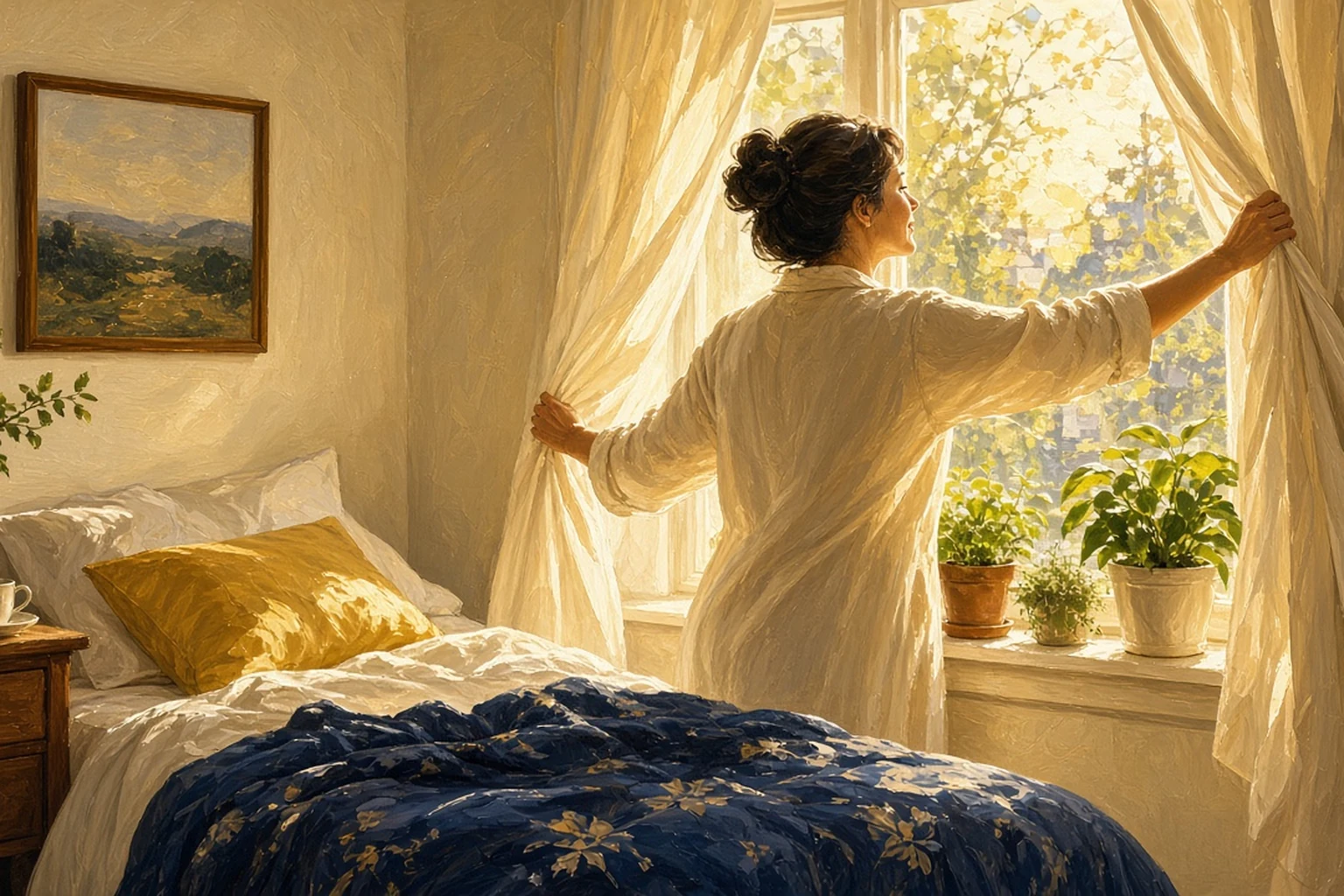
Central question: What keeps the body clock in step with the day, and why do some people naturally run earlier or later?
Timing matters
Light's effect on the body clock depends on when it arrives relative to your internal clock.
Chapter 2 introduced the body clock, a roughly 24-hour timer led by a central clock in the brain. To work well, your body clock needs to stay in step with the day around you. This chapter explains what keeps it in step, and why that process works differently for different people and at different times.
Light sets the clock
Light reaching your eyes is the main cue that keeps your body clock in step with day and night. Light signals travel from the eyes to the central clock in the brain, which helps coordinate timing across the body.
Other cues matter too. Meal timing and physical activity also influence the clock, usually less than light.
Timing matters
Light does not have the same effect at every hour. Light's effect on the body clock depends on when it arrives relative to your internal clock.
For people on a regular nighttime sleep schedule, bright morning light tends to move timing earlier, and bright evening light tends to move it later. Light at some other times has less predictable effects.
For people working nights or rotating shifts, the same wall-clock time can act differently, because their internal night may not match the outside night. That is why this Pathway does not offer one light rule for everyone. The useful idea is the principle: what matters is when light arrives compared with your own internal clock, not just what the clock on the wall says.
Melatonin is a darkness signal
Your body makes its own melatonin. It releases melatonin mainly during its evening and night, and bright light at that time can hold melatonin back. Melatonin is a darkness and timing signal, not a sleeping pill.
That raises a common question about screens. Bright light in the evening can hold back melatonin. Still, absolute claims that evening screen light ruins adult sleep, or that blue-blocking products fix it, are not well supported. For many people, stimulating late-night use, such as an engaging show or a busy inbox, can delay winding down.
Melatonin supplements may help certain timing-related problems for some people, but they are not a general fix for everyday poor sleep or chronic insomnia, so ask a clinician or pharmacist before using one.
Chronotype: a tendency of your clock
Some people's body clocks naturally favor earlier timing. Others favor later timing. This natural tendency is called chronotype.
Chronotype helps explain why some people feel "early" and others feel "late." It relates to the body clock rather than willpower. Chronotype is a tendency, not a diagnosis, and not everyone fits a simple early or late type.
Preferred timing also shifts across the lifespan. Teens often tend later, and timing often moves earlier with age.
This matters when a body clock that tends to run late meets work or school hours that start early. The result is a timing mismatch, not a character flaw. Chapter 4 looks at timing problems more closely.
The clock adjusts gradually
The body clock does not reset on command. It adjusts gradually after schedule changes such as travel across time zones or a move to night shifts. That is why a long trip or a new shift pattern can leave the clock out of step for a while. How fully night-shift workers adapt varies from person to person.
When the body clock stays out of step with a needed schedule and affects daily life, a clinician can evaluate it. Chapters 4 and 6 return to this.
What to remember
Light reaching the eyes is the main signal that sets the body clock, and its effect depends on when it arrives relative to your internal clock. Your body's own melatonin is a darkness signal. Chronotype is a natural tendency of the clock to run earlier or later. The clock adjusts gradually, not on command.
Explore this further in the Wellness Library
- Blue Light Impact on Sleep, Headaches & Health
This chapter is general health education, not diagnosis or treatment.
Sources for this chapter
- National Heart, Lung, and Blood Institute. Your Sleep/Wake Cycle. Updated March 24, 2022.
- National Institute for Occupational Safety and Health. Effects of Light on Circadian Rhythms (archived CDC copy). Last reviewed March 31, 2020.
- National Institute for Occupational Safety and Health. Light (night and evening shift module).
- National Institute of General Medical Sciences. Circadian Rhythms. Reviewed September 2023.
- National Heart, Lung, and Blood Institute. Circadian Rhythm Disorders. Updated March 24, 2022.
- National Center for Complementary and Integrative Health. Melatonin: What You Need To Know. Updated May 2024.
- Hartstein LE, et al. The impact of screen use on sleep health across the lifespan: A National Sleep Foundation consensus statement. Sleep Health. 2024;10(4):373-384.