
Sample month · Featured Pathway
Sleep is a body system
Every later chapter builds on one idea. Sleep is a real need with its own structure, not time taken away from the rest of your life.
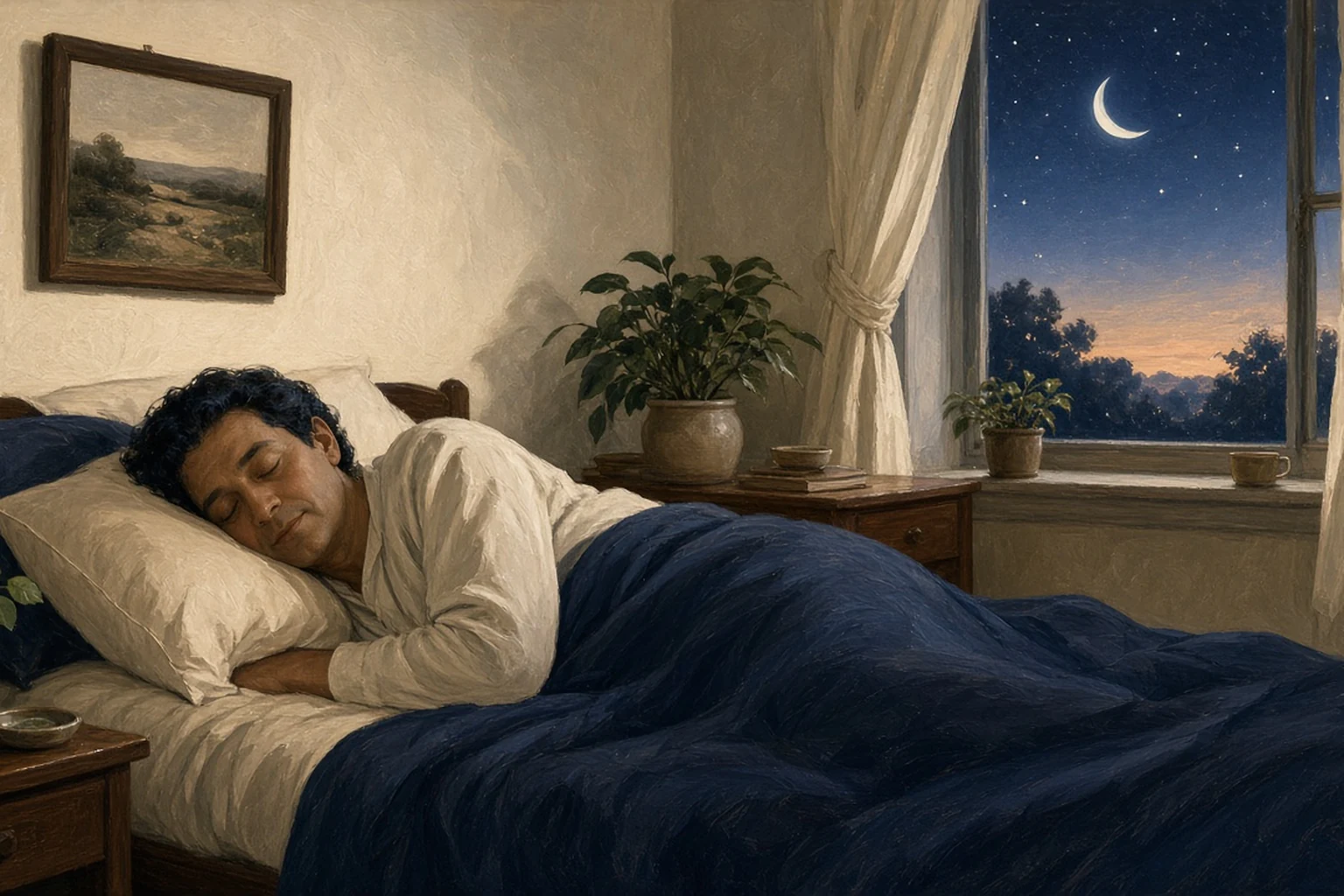
Central question: What is sleep for, how is a night organized, and how much do adults need?
Stages work together
Lighter sleep is part of a normal night, not failed deep sleep.
From the outside, sleep can look like nothing is happening. You lie still, your eyes close, and hours pass.
Inside, a lot is going on. Sleep is an active, essential body process. During sleep, your body supports healthy brain function, including attention, learning, and memory. Sleep also supports mood and physical recovery. Sleep is not lost time, and it is not optional downtime.
Sleep also helps regulate immune activity, and too little or disrupted sleep can interfere with that regulation, though sleep is not a way to "boost" immunity or a replacement for vaccines or medical care. For more on that connection, see the sleep and recovery section of the Understanding Chronic Inflammation Pathway.
A night is several laps, not one long dive
A night of sleep is not one steady state. Across a night, sleep moves through several repeating cycles of non-REM sleep and REM sleep.
Lighter non-REM sleep includes stage 1, the transition into sleep, and stage 2, when you are asleep. These stages are easier to wake from than deep sleep.
Deep sleep, also called slow-wave sleep, is the hardest stage to wake from. REM sleep involves an active brain, usually dreaming, and muscles that normally go limp.
The cycles repeat, but their makeup changes across the night. Deep (slow-wave) sleep is usually more common early in the night. REM sleep is usually more common later in the night.
You may have heard that one stage is "for the body" and another is "for the mind," or that one stage is the only one that really counts. That picture is too tidy. Stages differ in how easy they are to wake from, what the brain is doing, and when they are more common. The stages work together. The jobs of sleep belong to sleep as a whole.
Lighter sleep is part of a normal night, not failed deep sleep. Deep sleep contributes to feeling refreshed, while both non-REM and REM sleep help support memory. Their contributions overlap, so no single stage accounts for all the benefits of sleep.
Brief awakenings can be normal
Because sleep moves in cycles, you may wake briefly between them. Brief awakenings can be a normal part of sleep.
Healthy sleep does not mean a perfectly uninterrupted night. A night with a few short wake-ups can still be a good night of sleep.
Sleep that is repeatedly broken up is a different matter. Chapter 4 explains that difference, because it helps separate ordinary nights from problems worth a closer look.
How much sleep adults need
Most healthy adults need at least seven hours of sleep regularly. Individual needs vary, so the familiar "eight hours" is not an exact rule for everyone. You may also see adult sleep need described as about 7 to 9 hours.
Many people believe they have trained themselves to need less. A common myth is that people can learn to get by on little sleep with no negative effects. People who regularly get little sleep may not fully notice how it affects them, and some still think they are functioning well. Feeling used to short sleep does not prove the need went away.
This is not about blame. Work, caregiving, and other demands shape how much time people have for sleep. Chapter 4 treats not having enough time for sleep as its own kind of problem.
Over time, not getting enough sleep is associated with several health problems. Association does not prove that poor sleep causes every linked condition. This Pathway focuses on how sleep works, not on a list of risks.
Three things worth noticing
Many people now use a watch, ring, or app that estimates their sleep stages. A tracker's stage estimate is only one piece of information. It cannot tell the whole story of your sleep or replace a clinical evaluation. Consumer sleep trackers estimate sleep. A consumer sleep score cannot establish or rule out a sleep disorder.
A more useful way to think about your sleep is to notice three separate things:
- whether you are getting enough sleep
- how often your sleep is disrupted
- how you feel and function during the day
These are separate things worth noticing. A tracker score does not replace them.
Some sleep problems are not solved by more time in bed, and a device reading does not replace talking with a clinician. If you have an ongoing sleep problem or daytime sleepiness, talk with a clinician regardless of what a device shows. Chapters 4 and 6 explain more.
What to remember
Sleep is an active body process, not downtime. A night moves through repeating cycles whose stages differ but work together, and brief awakenings can be normal. Most healthy adults need at least seven hours regularly, with individual variation. A tracker's estimate is only one piece of the picture.
Explore this further in the Wellness Library
- Sleep Connection to Brain Health
- Understanding Chronic Inflammation Pathway (Step 5: sleep and recovery)
This chapter is general health education, not diagnosis or treatment.
Sources for this chapter
- National Heart, Lung, and Blood Institute. Why Is Sleep Important? Updated March 24, 2022.
- National Institute of Neurological Disorders and Stroke. Brain Basics: Understanding Sleep.
- National Institute of Neurological Disorders and Stroke. Understanding Sleep (Brain Basics) (PDF version). Publication date May 2024.
- Centers for Disease Control and Prevention. About Sleep. May 15, 2024.
- National Heart, Lung, and Blood Institute. Sleep Phases and Stages. Updated March 24, 2022.
- National Heart, Lung, and Blood Institute. What Are Sleep Deprivation and Deficiency? Updated March 24, 2022.
- National Heart, Lung, and Blood Institute. How Sleep Affects Your Health.
- Khosla S, et al. American Academy of Sleep Medicine. Consumer Sleep Technology: An American Academy of Sleep Medicine Position Statement. Journal of Clinical Sleep Medicine. 2018;14(5):877-880.